The vaguely green-fingered thoughts of a rambling rose.

Showing posts with label photinia red robin. Show all posts

An outlook less bleak


Covid-19 is causing unprecedented turmoil across the globe.  In the UK, the government has promised to pay up to 80% of the wages to try to prevent huge job losses, there are financial packages being implemented to try to reduce the risk of companies folding and mindless selfish people are stripping shelves of all manner of goods, without a care for anyone else, and regardless of whether they will actually use the stuff they've bought before it spoils, and the added risk of spreading the virus further!

However, while the human race hurtles towards impending doom, Mother Nature is quietly smiling to herself as fewer emissions choke the planet while lockdowns and self-isolations increase.

The sun continues to rise and set, continues to warm the soil as spring settles in.  Leaves are unfurling on trees, shrubs and bushes.  Insects come out of hibernation and go about their lives.  Herbaceous perennials thrust into the light and the birds busy themselves hatching and raising their young.  Not in the slightest are they bothered by pubs closing or how many toilet rolls they can stockpile.  Mother Nature will provide the necessities the creatures of our world. The Circle of Life will continue, all the more without humans poisoning the planet. 


Fresh red foliage of photinia Red Robin.


Swelling flower buds on magnolia George Henry Kerns in the Long Border. 
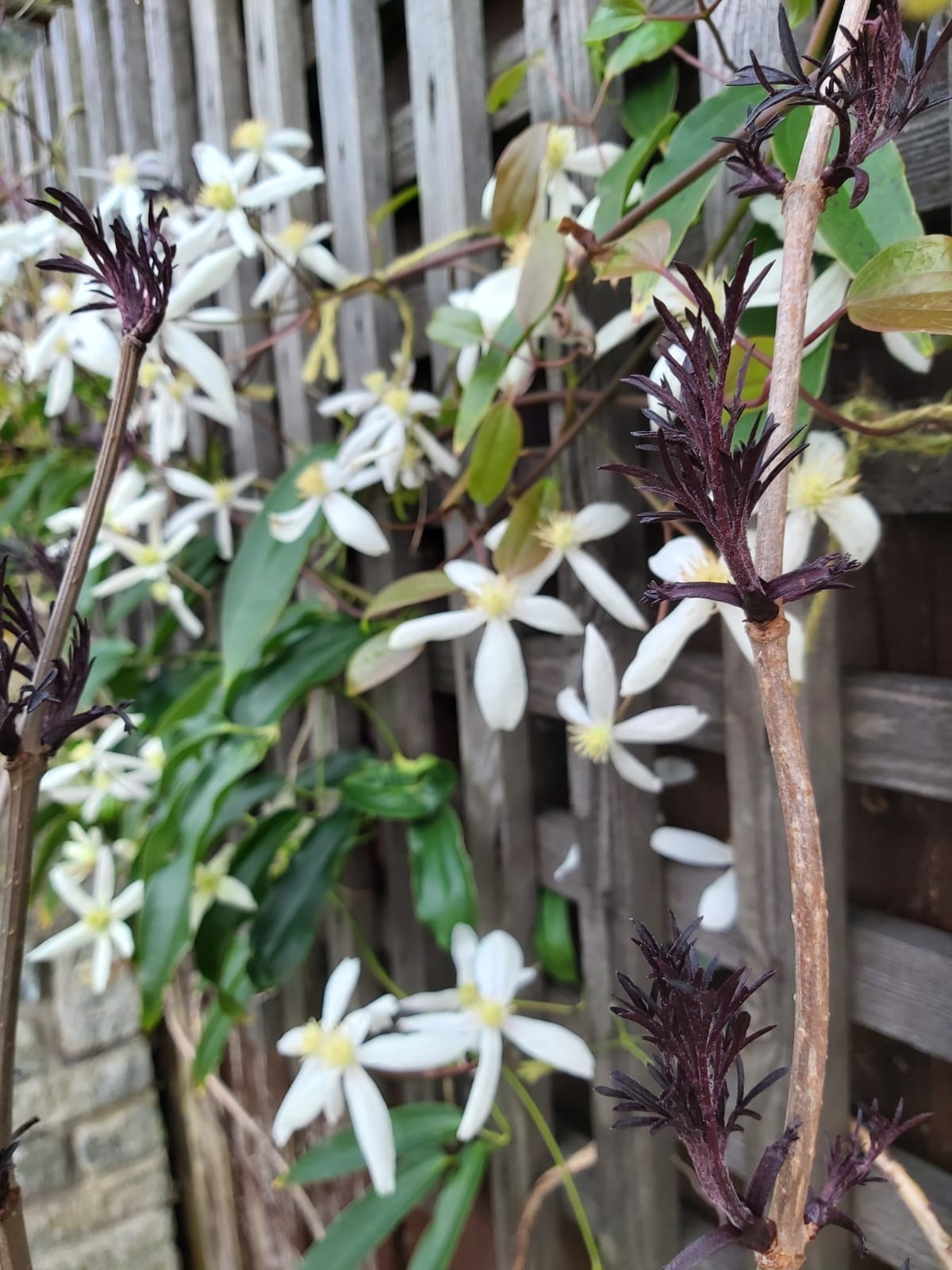

Clematis Armandii and filigree purple-black foliage emerging from sambucus nigra Black Lace in the Terrace Border. 


Euonymus elatus Blade Runner looks quite uninviting at the moment but the leaf buds are appearing and will soon soften the effect. 


All the hydrangeas are still wearing last year's faded papery bracts.  It's a little soon to remove them just yet as they are helping to protect the emerging buds beneath from spring frosts.


Take a moment in the fresh air, whether that is in an open space adhering to the social distancing protocols, in you own garden, or just by opening a window.


Now listen. Not to the low thrum of traffic but to nature. Bees are humming.  Frogs are calling and the birds are providing a stunning musical masterpiece.  


Now watch. Not the people walking by but nature.  Get close if you can. Take pictures. The zoom in features on mobile phones are amazing now and almost all the blog photos are taken on our phones.  
Watch those bees foraging. Watch the frogs pootling about in the pond, laying spawn, catching early midges.  Watch the birds as they go about their day, attending to nests, firkling about on a sunny wall to pick off insects in the nooks and crannies.  Watch the birds visiting a water source having a bath and a drink or squabbling over the best feeders.  It can be very entertaining. 


Now act!

Find a shallow container, a lid from a container, a dustbin lid even.  I use large saucers designed for large plant pots and put a rock in at the edge for stability, and fill with water for the birds.  
Use a smaller lid and fill with marbles before adding water for insects.

Clean out that grotty looking bird feeder and fill with fresh seeds. Use a variety of different foods to encourage different birds.

  We have a block of fat with berries, seeds and mealworms in it, which tits and robins like.  One of our male blackbirds has learned to hover to pick at this.  We also have feeders with niger seeds for goldfinches, sunflower hearts are adored by almost all our feathered visitors, along with a seed mixture, and I have another feeder for mealworms.  The feeders are all designed to prevent larger birds (starlings will empty all feeders in one sitting!) but the starlings, wood pigeons and other blackbirds do hoover up all the food that is dropped.  We also have other visitors including at least one wren, greenfinches, dunnocks, bluetits, long tailed tits, coaltits and great tits.

Plant wildlife encouraging plants and shrubs.  Look for evergreens to help with hiding places.  Look for trees and shrubs that feature berries.  Look for open flowers rather than double frilly pom poms to help pollinating insects.  Labels will help point you in the right direction as they will often have a picture of a bird or bee on them.

Choose perennials and shrubs over seasonal bedding if you cannot afford much.  Seasonal bedding usually lasts for that season only,  whereas perennials and shrubs perform year after year.  If you're fortunate enough to have a Botanical Garden close by, or maybe even a local allotment shop, plants are so much cheaper than the garden centre.  Places like B&Q sell off plants very cheaply as they go over - pretty much all my spring bulbs have been bought for pennies, and okay I have to wait a year to enjoy the flowers but oh boy are they sweeter for it!


Remember that there are four seasons and plant accordingly to ensure there's something to assist wildlife in each season.  This might be early blooms such as hellebores for those earliest emerging pollinators. Spring and summer are easier of course with blossoms, open landing pads like the various daisies, simple roses and lavender.  Then of course late flowering sedums, and all those lovely berries to take them into winter.  Don't be afraid to leave dying stems and flower heads, particularly if they're hollow where beneficial insects can hibernate inside, or provide a few bug hotels.

Leave the pesticides alone.  Remember the Circle of Life.  If there are too many green fly on your rosebuds, don a pair of marigolds if you're squeamish and squish them!  Go out with a torch at night and pick off snails and slugs, and handfork over the bare patches of soil before the plants fill out to unearth clusters of their eggs for the birds.

Recycling doesn't just involve plastics and paper.  Gardeners are constantly recycling.  We have 6 waterbutts...rainwater is free.
We also have 4 compost bins.  All the plant waste, egg shells and vegetable waste and spent teabags from the kitchen are recycled.  This all rots down and is spread onto the borders to improve the soil...again, for free!


Make 2020 the year you help Mother Nature.  Make 2020 the year you care.

Keep safe.  Keep well xx


Another Bank Holiday Weekend


But vastly different from the last as there's very much a chill in the air.

Bank holidays are generally big business for garden centres who are more than happy for you to hand over your hard earned cash in return for great looking summer bedding plants...but beware as there's a frost looming that can kill those young plants.  Bring them into a porch, shed or garage if you don't have a greenhouse or coldframe.  If that isn't possible, throw over some fleece and tuck them up against the house.


The roses are beginning to flower, thanks to the unseasonably warm April.


At the top, orange r. Maigold in the front garden, pink r. Special Daughter in the Terrace Border...


...and white r. Margaret Merrill also in the front garden.  I hope they make it safely through the cold snap.


In the Yen Garden the Cotinus coggygria (smoke bush) is finally coming into leaf.  It's difficult to get the light right to show just how beautifully vivid the red-purple foliage is.


The rhododendron is happily joining the spectacle too.


With a backdrop of hundreds of pale pink clematis Montana Rubens blooms, the final daffs sing out.


A little movement in the Long Border is required to fit in another tree.


Having removed the syringa Sensation which didn't seem to be particularly thriving in the Long Border, the Photinia red robin standard (which is still a work in progress) has been moved along and the new tree planted.


The label states that it is an Acer aureum but it doesn't have the promised red new foliage.  I couldn't find a picture of the bark on t'interweb but I'm certain the blurb somewhere would mention the unusual colouring and stripes. 


We have therefore contacted the nursery for confirmation of the variety. 


The syringa Sensation has been replanted in the Terrace Border in full sunshine which should improve the vigour and flowers.


Aquilegias, as mentioned last time, are quite promiscuous and cross so easily.  This can produce some lovely variations. 


In the newly emerging Mugwort's Retreat, a new seating area is being created.


This will form a much needed private area now that our neighbour has converted their loft including a balcony with doors.  Their views must be amazing, but it's made my agoraphobia kick in again, hence all the trees.  Making a garden is a wonderful task.  Not being able to actually sit in it to enjoy all that beauty is so heartbreaking. 

On a brighter note, a young robin has been happily pottering about in the back garden while we work, coming closer and closer to see what goodies we might be digging up.  We hadn't seen our usual robin since last autumn (hopefully old age rather than the neighbour's cat has been responsible).


This new robin looks young and sleek.  Today he discovered the bird feeders in the front garden.  He spent around 5 minutes on a recon before flitting off again.  He's easily unnerved by the marauding sparrows but if he's anything like his predecessor, he'll soon make our patch his territory and defend it fiercely.

Other new visitors spotted today were a pair of greenfinches! It's been a couple of years since they were last seen but I could hear their distinctive voices before they descended on the sunflower hearts.

Our bird feeders are positioned just outside our sitting room window at the front, and keep me entertained for many hours.  Along with sparrows, regular feathered friends include goldfinches, long tailed tits, coal tits, great tits, blue tits and blackbirds.  The latter are very amusing to watch in the birdbath, which is a large black plastic plantpot saucer on a stack of bricks to raise it to viewing height.  We put a couple of rocks in it to keep it steady and it's relatively secluded beneath the Photinia in the front garden.  All the birds use it, whether to bathe or drink from it so it is regularly cleaned and replenished. There is another saucer-bath set up in the Long Border.  It's thirsty work raising chicks!

Storm Hannah and April Showers


Thankfully our part of the UK came out relatively unscathed as Storm Hannah bore down on Saturday, bringing winds of up to 82mph and leaving homes without power.  It was very wet and very windy but not half as bad as those in the West.  I guess the Pennines protected us somewhat.  

Rather than spending any time in the garden on Saturday, we visited a garden centre and bought yet another tree!  It's being delivered next week, so I'll tell all then.

Sunday is calm and bright with a gentle breeze. A good day to work in the garden.


First up, the Pittosporum tenufolium Variegatum we bought over the bank holiday. This looks like an odd place to plant a shrub as it's beside the steps and the first compost bin.  The method in my madness is simple.  When sitting in our almost finished Mugwort's Retreat, the view ain't pretty of the workspace with its plastic bins, bags of manure, ericaceous and John Innes no 2.  Eventually this will create a screen from the new seats.


The other plant is the hebe Mrs Winder we also bought last week.  There had been a lavender on either side of the patio arch but the one in the right hand side was miserable.  I've never really had much joy with lavender so I was surprised that the one in the left is still flourishing so beautifully.  Therefore the failing lavender has been replaced with the hebe, which also has purple flowers loved by bees.


Other tasks completed today included tying in c. Armandii and the roses either side of the patio arch.


The other rhododendron in the Yen is about to bloom.


And look! A flower is forming on the Wisteria at long last (just the one though).  I didn't do any pruning over winter so maybe I was doing it wrong.


Also in the Yen, the storm cut short the blossom display of the cherry and apple trees but clematis Shikoo is opening 


Another first is this butterfly.  It's a male orange tip as the female doesn't have the distinctive orange tips (excuse the greenfly on this fringed tulip, the predators haven't caught up yet).


At the rear of the Yen pergola, the first aquilegias are beginning to flower.  Monty recently did a piece on Gardener's World about how to sow the seeds indoors but I've found no problems getting these plants to germinate simply by scattering the seeds after flowering where you want them to grow.  They're very very easy to propagate and pot up any excess for friends and family. 


A pink pairing of magnolia George Henry Kern and clematis Montana Rubens creates a nice pop of spring colour in the corner of the Patio Border and the Long Border 


The "flowers" of the acer in the front garden are quite prominent as the leaves change colour.


And this year, again I think due to the timing of the pruning, the Photinia is flowering. I don't think I've seen it flower before.


On the right side of the patio border, only 2 pink tulips have flowered.


And only two white ones on the left.


These are new tulips in Mugwort's Retreat.  


And new near-black ones in the Terrace Border.


Red and near-black tulips in the front garden have lasted a few years.


 At 523 feet above sea level we appear to need to lift and store or annually replace our tulips.  The new ones have been planted deeper, as per our Dutch friends, so the experiment continues.


This vivid pink azalea has survived being moved a few times and is happiest in the Long Border. 


A pot of self seeders currently on the terrace, I don't have the heart to move them into the garden just yet.